
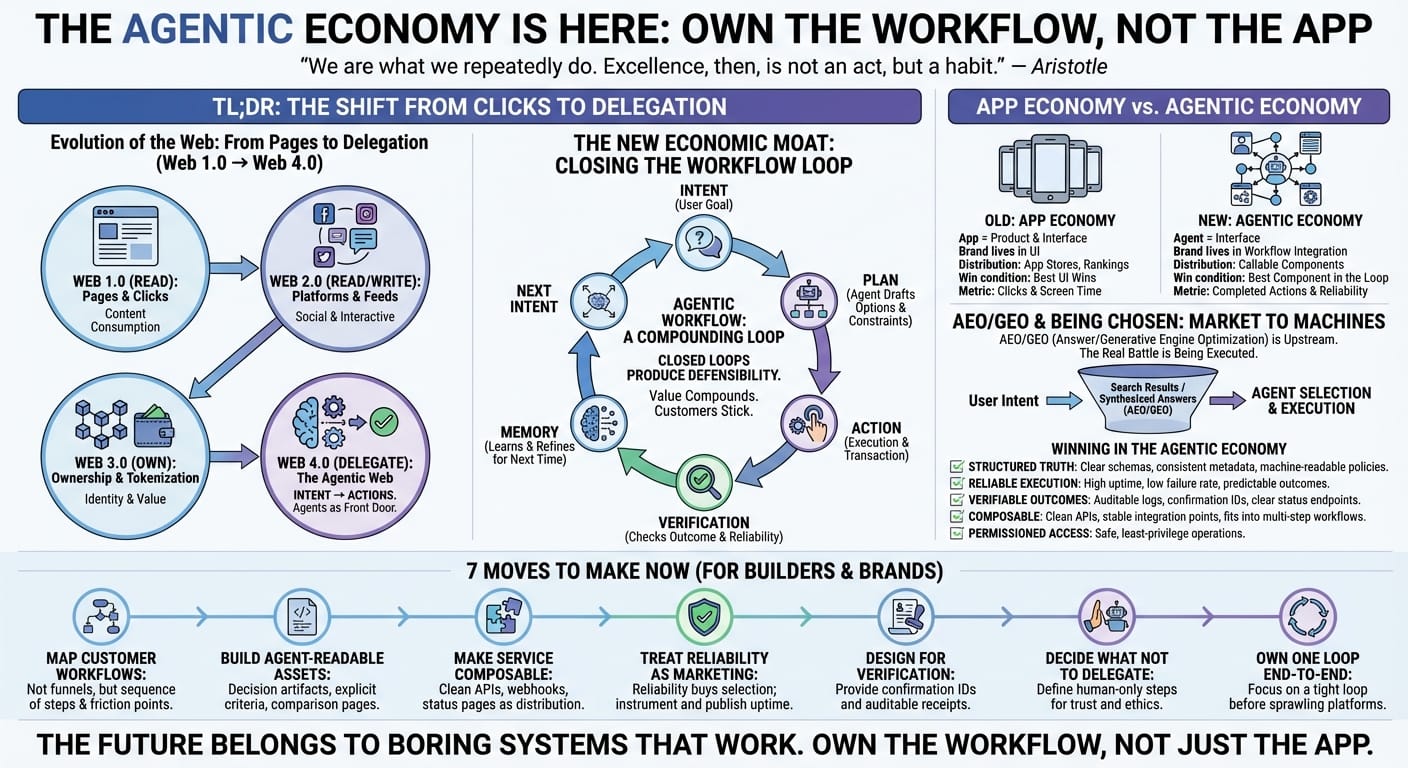
The Agentic Economy Is Here: Own the Workflow, Not the App
“We are what we repeatedly do. Excellence, then, is not an act, but a habit.” - Aristotle
TL;DR
- The internet is shifting from clicks to delegation: intent → actions.
- In the agentic economy, apps don’t disappear, but distribution moves to workflows.
- The moat is owning a closed loop (intent → plan → action → verify → memory), not a shiny UI.
- “AEO/GEO” is upstream; the real battle is being chosen + executed inside agent workflows.
- To win: make your offer machine-legible, reliable, verifiable, and composable.
Last week I watched a tiny, unremarkable task turn into a small existential crisis.
Not the “life is meaningless” kind. The “wait, who owns this now?” kind.
A friend asked me to help plan a work trip: dates, flight constraints, hotel preferences, meeting locations, and a rough itinerary that didn’t feel like a punishment. In the old world, this is a familiar ritual. You open five tabs, compare prices, skim reviews, copy/paste addresses, get lost in a calendar, and eventually produce something that looks like a plan.
In the new world, you hand it to an agent.
Not a chatbot that talks about planning. An agent that can do planning: it asks for clarifying constraints, searches, drafts options, checks for conflicts, proposes trade-offs, and outputs a decision-ready packet. If it’s connected to your tools, it can even book, schedule, and notify.
Here’s the unsettling part: the value didn’t come from any single app. Not from the airline site. Not from the hotel chain. Not from a map. Not from a calendar. The value came from the workflow, the sequence of steps that turns “I need to go” into “it’s booked, it’s on my calendar, and everyone knows where to be.”
That’s the agentic economy in a nutshell.
And if you’re building, investing, marketing, or simply trying to stay employed, the question in front of you is no longer “What app should I use?” It’s:
Who owns the workflow?
Because the owner of the workflow increasingly owns the customer.
Web 4.0: not pages, not feeds: delegation
We’ve been using “Web 3.0 / Web3” as a cultural bookmark for years, mostly to argue about blockchains. But if you zoom out, the real shift happening now isn’t about tokens. It’s about delegation.
- Web 1.0 gave us pages (read).
- Web 2.0 gave us platforms and feeds (read/write, socialize).
- Web 3.0 promised ownership rails (identity, value transfer).
- Web 4.0 - the one arriving whether we rename it or not - is the agentic web: intent → actions.
The interface moves up a level. We stop navigating software and start describing outcomes.
And when that happens, the classic app economy - where distribution flows through icons, rankings, and habitual launches - starts to thin out. Not vanish. Thin out.
Because the agent becomes the new front door.
AEO/GEO is a signal, not the destination
If you’ve been tracking AEO (Answer Engine Optimization) and GEO (Generative Engine Optimization), you’ve seen the first wave: search results turning into synthesized answers, brand visibility shifting from “ranked links” to “quoted sources,” and content strategies adapting.
That matters. But it’s still upstream.
AEO/GEO is about being present in the answer.
The agentic economy is about being present in the action.
When the user says:
“Find the best option and handle it.”
…the competitive battlefield isn’t just what gets cited. It’s what gets selected, what gets executed, and what gets repeated automatically next time.
In other words, the new SEO is not just “show up.” It’s “get chosen by the workflow.”
And workflows don’t choose like humans do. They choose based on constraints, reliability, structured data, permissions, API access, and measured outcomes.
If you’re used to marketing to people, welcome to the new requirement: market to machines that represent people.
“Agents over apps” doesn’t mean apps die - distribution changes
Let’s say this cleanly: apps aren’t going away.
What changes is the distribution gradient.
In an app-first world, the app is the product and the interface. Users learn it, trust it, and return to it. The brand lives in the UI.
In an agent-first world, the agent becomes the interface. The brand increasingly lives in:
- how well you plug into workflows,
- how reliably you fulfill intents,
- how legible your offering is to machines,
- and how safely you operate with delegated authority.
Your product can still be an app - but your growth may depend on being the best callable component inside someone else’s agent.
That’s a painful sentence for anyone who built a business on “owning the surface area.”
It’s also a huge opportunity for anyone willing to own the loop instead.
The real product: a loop that closes
Here’s a useful mental model:
A workflow is a sequence.
An agentic workflow is a loop.
Loop = intent → plan → action → verification → memory → next intent
That “verification” and “memory” part is the difference between a one-off automation and a compounding system.
- It doesn’t just send an email; it checks if the email got a response.
- It doesn’t just schedule a meeting; it confirms attendance and adjusts when someone can’t make it.
- It doesn’t just recommend a tool; it tracks whether the tool improved the outcome.
When loops close, value compounds. When loops compound, customers stick. When customers stick, markets reorganize.
This is why “agentic” isn’t a feature. It’s an economic shift: closed loops produce defensibility.
Workflow ownership: the new moat (and the new fight)
If you want to predict where the agentic economy goes, follow the ownership question.
Who wants to own workflows?
- Model providers want to own the interface (chat, voice, multimodal) and become the default delegate.
- Cloud and platform providers want to own the orchestration layer (identity, security, tool access, governance).
- SaaS incumbents want to keep workflows inside their suites (CRM, productivity, ERP).
- Vertical specialists want to own high-stakes loops (healthcare intake, insurance claims, supply chain exceptions).
- Startups want to own one narrow loop end-to-end and expand outward.
This isn’t theoretical. Major firms are already publishing about agentic systems, agent governance, and agentic organizations because they can see the center of gravity moving toward delegated workflows and oversight structures.
But the interesting part is what happens to everyone else - the businesses who don’t become the delegate, but still need to be chosen by it.
What “being chosen by an agent” actually requires
Humans are swayed by story, vibes, design, and a good landing page.
Agents are swayed by different things:
1) Structured truth
If your core offer can’t be expressed cleanly - price, availability, constraints, return policy, warranty, service levels - you’ll be harder to select.
Agents prefer:
- clear schemas,
- consistent metadata,
- predictable formats,
- machine-readable policies.
2) Reliable execution
Agents will route around unreliability fast. A human might tolerate one bad experience. An agent will learn: “That vendor fails 8% of the time; choose the one that fails 0.8%.”
3) Permissioned access
The best workflow component is useless if it can’t be called safely. This is why tool protocols, sandboxing, and least-privilege permissions are becoming central.
4) Verifiable outcomes
Agents will increasingly need to verify. “Did the order actually ship?” “Was the refund processed?” “Did the meeting get confirmed?” If you provide verifiable endpoints (status, receipts, confirmations), you become easier to trust.
5) Composability
The winners aren’t just good services; they’re good building blocks. They fit into multi-step workflows without breaking.
In the app economy, “best UI wins.”
In the agentic economy, best component in the loop wins.
The coming split: consumer agents vs. enterprise agents
Right now, we talk about “agents” like they’re one thing. They aren’t.
Consumer agents
They optimize for convenience, cost, time, and personal preference. They live close to the individual and their daily life: travel, shopping, scheduling, communications, personal knowledge management.
Their biggest issues:
- trust,
- privacy,
- permissions (especially for spending money),
- and alignment (did it do what you meant?).
Enterprise agents
They optimize for throughput, compliance, measurable outcomes, and governance. They live inside workflows that already have owners, approvals, audit trails, and policies.
Their biggest issues:
- access control,
- auditability,
- security boundaries,
- and integration with messy systems.
Both will grow. But the enterprise side may reorganize faster because businesses can justify the integration work when ROI is measurable.
And that leads to a reality check: the first big agentic wins won’t be magical assistants. They’ll be boring workflows that stop breaking.
Why this feels like a “search” story (but isn’t only search)
A lot of people will experience this shift through search first:
- results → answers,
- answers → recommended actions,
- recommended actions → executed actions.
So yes, AEO/GEO is part of it. If you run a publication or a content-led business, it’s a survival skill.
But the deeper story is that discovery becomes a function inside a workflow rather than a standalone activity.
In plain terms: people won’t “go research” as a separate phase. They’ll delegate research as a step in getting something done.
That means your content strategy can’t just be “rank for keywords.” It has to be:
- “be the best reference for an agent to cite,” and
- “be the best option for an agent to choose,” and
- “be the safest, most reliable endpoint for an agent to transact with.”
That’s a tall order. Which is exactly why it’s an opportunity.
A practical field guide: 7 moves to make now
If you’re building a business (or a personal brand) in this transition, here are concrete moves that map to the agentic economy.
1) Map your customers’ workflows, not your funnel
Funnels are marketing abstractions. Workflows are reality.
Ask:
- What sequence of steps leads to the outcome?
- Where do people get stuck?
- Where do they copy/paste?
- Where do they wait on someone else?
- Where do they lose trust?
Those friction points are the first places agents will bite.
2) Build “agent-readable” assets
Not just blog posts - decision artifacts:
- comparison pages with explicit criteria,
- pricing and policy pages that don’t hide the ball,
- FAQs that answer with constraints and edge cases,
- specs that a machine can parse without guessing.
3) Make your service composable
If you have APIs, make them clean. If you don’t, create stable integration points:
- exports,
- webhooks,
- status pages,
- receipts and confirmations,
- structured emails.
Composability is distribution.
4) Treat reliability as marketing
In the app economy, brand buys forgiveness.
In the agentic economy, reliability buys selection.
Instrument your core actions, publish uptime where appropriate, and reduce “human-only” steps that break automated loops.
5) Design for verification
Agents need to know: did it work?
Add:
- confirmation IDs,
- auditable logs,
- clear status endpoints,
- and receipts that can be reconciled.
6) Decide what you will not delegate
This is the human part. Not everything should be delegated, especially where values or high stakes are involved.
A good brand in the agentic economy will say:
- “Here’s what we automate.”
- “Here’s what requires explicit approval.”
- “Here’s what we will never do without a human.”
This isn’t just ethics. It’s trust - and trust will be a competitive advantage.
7) Own one loop end-to-end
If you’re early, don’t try to “be an agent platform.” Own a loop:
- “proposal → approval → booking → confirmation,”
- “lead capture → qualification → scheduling → follow-up,”
- “content brief → draft → review → publish → distribution tracking.”
Then expand.
The agentic economy rewards tight loops more than sprawling roadmaps.
The subtle cultural shift: from “knowing” to “directing”
There’s a second-order effect here that people don’t talk about enough.
When agents do more of the intermediate work, the scarce skill shifts from knowing how to do the steps to directing the system toward the right outcome.
That’s not laziness. It’s leverage.
But it will feel uncomfortable, especially for high-achievers whose identity is built on competence at the steps.
If you’re reading this and feeling a flicker of resistance - good. That’s the boundary of the old world.
The new world doesn’t reward the person who remembers the most menus. It rewards the person who can define intent, set constraints, evaluate trade-offs, and verify results.
In other words: taste, judgment, and accountability become the human premium.
So what is the agentic economy, really?
It’s the economy that forms when:
- Intents become interfaces (you express goals, not clicks),
- Agents become default delegates (software calls software),
- Workflows become the product (loops close, outcomes compound),
- Selection shifts from humans to systems (AEO/GEO is a symptom),
- Value accrues to whoever owns the loop (workflow ownership > app ownership).
If that sounds abstract, here’s the concrete version:
In five years, a meaningful portion of “the internet” won’t feel like browsing.
It will feel like assigning.
And in that world, the question “How do I get traffic?” becomes less important than:
How do I become the most reliable, verifiable, composable step in the workflows that matter?
Or, if you want the ambitious version:
How do I own the workflow people delegate to?
That’s the bet.
Closing: a note to builders (and a warning)
If you’re building in this era, resist two easy mistakes:
- Don’t confuse “agent” with “magic.”
The winners will be disciplined about boundaries, permissions, and verification. The future belongs to boring systems that work. - Don’t confuse “distribution” with “UI.”
Your next wave of customers may never see your homepage. They may meet you as a tool call inside someone else’s agent.
And that brings us back to my friend’s travel plan.
The most valuable thing produced wasn’t a booking confirmation. It was a reusable loop: preferences captured, constraints learned, an itinerary template, a playbook for next time. The trip wasn’t the product.
The workflow was.
Welcome to Web 4.0. Own the workflow.